

 InfoSearched
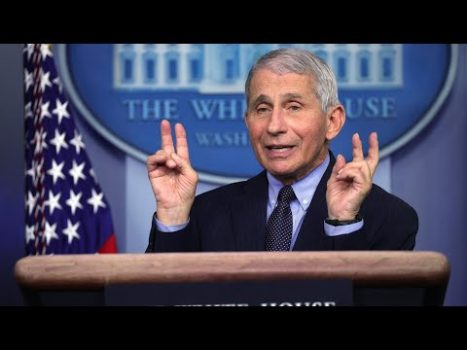
An Australian broadcaster pressed Dr. Anthony Fauci on the funding trail that led straight to Wuhan, and his own answer became the story.
Sky News Australia host Sharri Markson used a recent broadcast to walk through how the National Institutes of Health, through Dr. Anthony Fauci’s National Institute of Allergy and Infectious Diseases, funneled a sub-grant through the EcoHealth Alliance to the Wuhan Institute of Virology for research at what scientists call the “bat-human interface.” Markson’s argument wasn’t built on a leaked document or an anonymous source — it rested on Fauci’s own explanation for why the money went to China in the first place. That explanation, she argued, amounted to an admission that the U.S. outsourced risky coronavirus research abroad specifically to get ahead of a future outbreak at home.
- Fauci defended the NIH-funded sub-grant to the Wuhan Institute of Virology by arguing it would have been “almost irresponsible” not to study animal-to-human transmission in a region, China, where the original SARS outbreak emerged in 2003.
- Markson noted Fauci’s history of backing gain-of-function research, including 2012 comments arguing such work was worth pursuing despite the risk of triggering an accidental pandemic.
- Fauci played a central role when the U.S. lifted its 2014 moratorium on gain-of-function funding in December 2017, replacing it with the HHS P3CO review framework.
The Admission at the Center of Markson’s Report
The crux of Markson’s segment was straightforward: Fauci didn’t deny that NIH money reached the Wuhan lab through EcoHealth Alliance. Instead, he justified it. His reasoning was that dangerous coronaviruses circulate naturally in bat populations across China, and that ignoring the bat-human transmission pathway there — given SARS’s 2003 origin in the same region — would have been scientifically negligent. Markson framed that justification as the real story, arguing it confirmed the U.S. had bankrolled precisely the kind of research critics say needed far more scrutiny before the pandemic began.
Markson called the entire premise “unthinkable” — the idea that Washington would fund risky coronavirus experimentation overseas as a hedge against an outbreak reaching American shores, only to watch a coronavirus outbreak emerge from the same city hosting that research.
Gain-of-Function, 2012 to 2017
Markson’s report leaned heavily on Fauci’s long paper trail on gain-of-function research — experiments that deliberately enhance a pathogen’s transmissibility or lethality to study its potential threat. In 2012, with the U.S. debating whether to restrict such work, Fauci argued publicly that the scientific payoff justified the risk, even acknowledging the possibility it could help spark a pandemic.
It would have been almost irresponsible not to study animal-to-human transmission in a region where these viruses naturally circulate.
That position outlasted the 2014 funding moratorium the U.S. government imposed on gain-of-function studies. In December 2017, the moratorium was lifted and replaced with the HHS P3CO framework — a review process for “potential pandemic pathogens of concern.” Markson placed Fauci at the center of that reversal, arguing his advocacy directly shaped the policy environment that allowed the NIH funding to continue flowing toward high-risk coronavirus work, including the Wuhan sub-grant.
Rand Paul’s Congressional Pressure
Markson’s segment landed amid an escalating fight in Washington over the same funding trail. Senator Rand Paul repeatedly challenged Fauci in congressional hearings over the roughly $600,000 EcoHealth Alliance sub-award to the Wuhan Institute of Virology, pressing him on whether it financed gain-of-function experiments capable of engineering more dangerous viruses. Fauci and NIH Director Francis Collins have consistently denied the NIH approved or funded gain-of-function coronavirus work at the Wuhan lab.
That denial hasn’t settled the argument. Outside scientists such as Rutgers microbiologist Richard Ebright, along with a growing chorus of commentators, have argued Fauci withheld meaningful transparency about the Wuhan lab’s research activities in the early weeks of the pandemic — a criticism that has only sharpened as more of the funding paperwork has surfaced. The dispute has tracked alongside broader coverage of Fauci’s public standing, including reporting on his private assurances to the White House even as lab-leak emails complicated the picture, and his own public pushback when he called political attacks on him “bizarre.”
Paul’s line of questioning hasn’t gone away, and neither has the funding paperwork he’s citing. With Collins and Fauci sticking to their denial that any NIH dollars supported gain-of-function work in Wuhan, expect the same $600,000 sub-award to come up again the next time either man sits in front of Paul’s committee.





Fed’s Rosengren on Economy, Fiscal Policy, Negative Rates
President Trump extends coronavirus guidelines until April 30th
New York City death toll spikes with revised count
4 Quarantined Cruise Ship Passengers Share Their Experience
Coronavirus Second Wave Is Coming – Understand what it’s about and prepare