

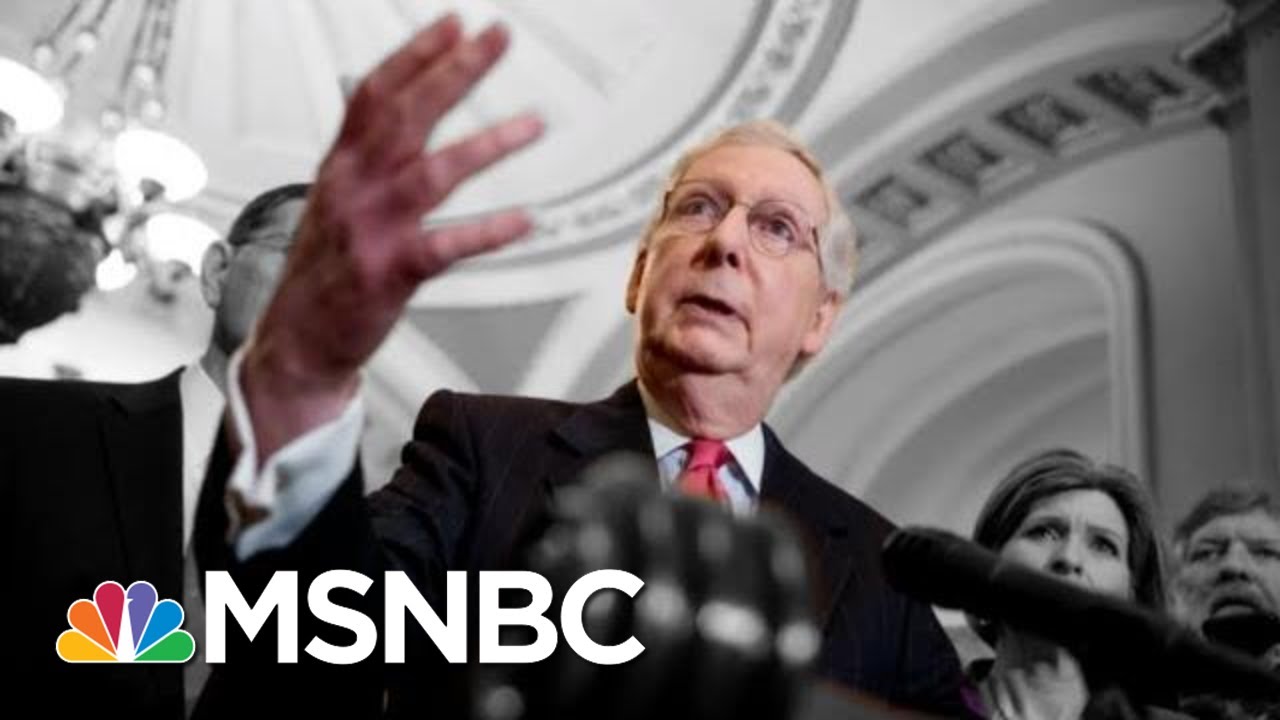
McConnell Bristles At ‘Moscow Mitch’ After Blocking Election Security Bill | The 11th Hour | MSNBC
 InfoSearched
Mitch McConnell’s blockade of election security legislation just earned him a nickname he can’t shake.
A week after Robert Mueller told Congress that Russian operatives were still working to interfere in American elections, Senate Majority Leader Mitch McConnell shut down two separate attempts to pass election security measures on the floor. The move drew immediate fire from Democrats, election watchdogs and columnists — and stuck him with a label he now insists is a smear. MSNBC’s The 11th Hour broke down the fallout with analysts Jeremy Bash and Peter Baker.
- On July 25, 2019, McConnell objected to unanimous consent requests from Chuck Schumer and Richard Blumenthal to fast-track House-passed election security bills mandating paper ballots and funding the Election Assistance Commission.
- The blockade came one day after Mueller testified, “They are doing it as we sit here,” and alongside a bipartisan Senate Intelligence Committee report exposing vulnerabilities in paperless state voting systems.
- After the Washington Post and MSNBC branded him “Moscow Mitch,” McConnell took to the Senate floor to call the nickname “modern-day McCarthyism.”
The Floor Fight Over Election Security
Schumer and Blumenthal tried twice to force quick passage of legislation the House had already approved — measures that would have required paper ballots nationwide, sent hundreds of millions in grants to the Election Assistance Commission, and forced campaigns to report foreign interference attempts directly to the FBI. Both times, McConnell objected under the Senate’s unanimous consent rules, which let a single senator kill a request outright. He dismissed the bills as “highly partisan” attempts to federalize elections that states and localities have always run, and argued the Trump administration had already taken adequate steps to shore up voting systems.
The timing made the objection land harder. Mueller had just told the House Intelligence Committee that Russian interference wasn’t a 2016 relic — it was ongoing. That warning, paired with the Senate Intelligence Committee’s own bipartisan findings on paperless voting machines and weak state infrastructure, gave Democrats a data-backed case that McConnell was sitting on legislation with actual national security implications, not just a messaging bill.
The Rise of Moscow Mitch
The nickname didn’t originate with a random tweet — it spread through mainstream commentary, with the Washington Post and MSNBC hosts framing McConnell’s obstruction as functionally aligned with Kremlin interests. Once it caught on across social media, McConnell couldn’t ignore it, and he didn’t try to. He used his floor time to attack the label directly rather than let it sit unanswered.
“They are doing it as we sit here,” Mueller told Congress — a line Democrats invoked repeatedly to justify fast-tracking the bills McConnell blocked days later.
McConnell’s response leaned on a familiar playbook: reframe the attack as an attack on his character rather than engage with the underlying vulnerability data. He called the “Moscow Mitch” branding “modern-day McCarthyism,” arguing Democrats were exploiting Mueller’s testimony to score points ahead of 2020 rather than genuinely fix election infrastructure. That defense is consistent with broader GOP resistance to what Republicans have long viewed as federal overreach into state-run elections — a tension that echoes other fights over the balance between Washington and the states.
Key Findings from Bash and Baker
On The 11th Hour, Jeremy Bash and Peter Baker walked through why the nickname stuck as hard as it did: McConnell wasn’t simply skeptical of one bill’s price tag or scope, he’d now blocked multiple separate attempts within days of the Mueller testimony, giving critics a clean narrative of a Senate leader standing between Congress and a fix for a documented vulnerability. Baker noted the political risk for McConnell heading into his own 2020 re-election in Kentucky, where Democrats were already testing whether the label could be weaponized against him. Bash focused on the substance — the House bills McConnell killed weren’t radical rewrites of election law, they were narrower fixes like paper-ballot backups and FBI reporting requirements for campaigns approached by foreign actors.
The Political Stakes for McConnell
McConnell’s objections didn’t kill election security funding outright — Congress had already appropriated $380 million for state grants earlier in 2019 — but his refusal to fast-track the House measures meant no additional legislative action moved before the August recess. For Democrats, that gap was the point: they wanted a floor vote precisely because McConnell controls what does and doesn’t get one as majority leader, and a public roll call would have forced Republicans to go on record days after Mueller’s warning.
McConnell’s own explanation — that federalizing election administration oversteps state authority and that the executive branch had already acted — is the same argument Senate Republicans have used against broader federal election mandates for years, tracing back to disputes over the reach of measures like the Help America Vote Act. Whether that argument outlasts the “Moscow Mitch” branding heading into 2020 is now as much a Kentucky campaign question as a Washington one.

Attorney speaks out after FBI arrests longtime Jeffrey Epstein associate
New, more contagious coronavirus strain discovered by researchers
Coronavirus precautions lead to rat problem in New Orleans
NYPD officers encouraged to call out sick on July 4th
Coronavirus Outbreak Worsens In Europe