

 InfoSearched
Vladimir Putin breaks his silence, and Washington answers with 3,000 more troops.
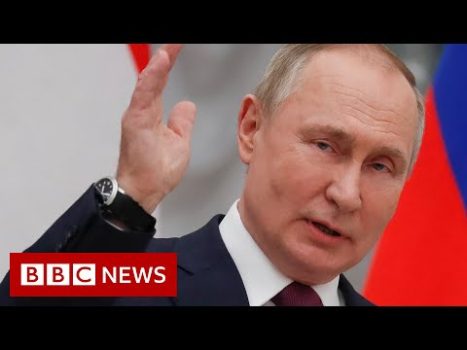
Nearly two months after he last spoke publicly about Ukraine, Vladimir Putin resurfaced on the crisis this week, using a joint appearance with Hungarian Prime Minister Viktor Orban to accuse the United States and NATO of ignoring Moscow’s core security demands. The remarks landed as an estimated 100,000 Russian troops sit along Ukraine’s borders, with additional forces flowing into Belarus for joint drills. Washington’s answer came within days: the Pentagon is sending nearly 3,000 more American troops to Eastern Europe.
- Putin, in his first public comments on Ukraine since December 2021, said the U.S. response ignored three fundamental Russian demands: a legal bar on Ukraine ever joining NATO, an end to eastward alliance expansion, and a pullback of NATO infrastructure to pre-1997 positions.
- The Pentagon announced on February 2 that nearly 3,000 additional U.S. troops would deploy to Poland and Romania to reinforce NATO’s eastern flank.
- Volodymyr Zelensky signed a decree to grow Ukraine’s armed forces by 100,000 personnel over three years, as Ukrainian officials warned a Russian incursion would trigger full-scale conflict across Europe.
Putin’s First Words Since December
Putin had gone quiet on Ukraine for weeks while his generals moved hardware and personnel toward the border. That changed after his sit-down with Orban, when he told reporters that Washington was treating Ukraine as a tool to contain Russia and, in his telling, to draw Moscow into an armed conflict it didn’t want. He framed the entire standoff around three demands Moscow says the U.S. and NATO have brushed aside: a binding guarantee that Kyiv never enters NATO, a freeze on the alliance’s eastward growth, and a rollback of NATO military infrastructure to where it stood before 1997 — essentially before most of Eastern Europe joined.
Moscow wants it in writing: no NATO membership for Ukraine, no further eastward expansion, and alliance infrastructure pulled back to 1997 lines.
The Troop Numbers on Both Sides
The scale of the buildup is what’s forcing everyone’s hand. Roughly 100,000 Russian troops are positioned along Ukraine’s frontiers, with more forces and equipment moving into Belarus under the banner of joint military exercises — placing Russian units within striking distance of Kyiv from the north as well as the east. For deeper detail on how that Belarus dimension has evolved, see our coverage of the shifting power arrangements in Minsk.
On the other side of the ledger, the Biden administration confirmed on February 2 that nearly 3,000 additional U.S. troops would head to Poland and Romania, bolstering NATO’s eastern flank rather than putting American forces inside Ukraine itself. It’s a distinction the administration has repeated deliberately: reinforce the alliance, don’t put U.S. boots on Ukrainian soil.
Washington’s Answer: Ukraine’s Choice, Not Russia’s Veto
The Biden administration’s public line has stayed consistent: NATO operates an open-door policy, and Ukraine — as a sovereign state — gets to decide its own security partnerships, full stop. That’s a direct rejection of Putin’s demand for a written guarantee barring Kyiv from ever joining the alliance, and it’s the single biggest sticking point keeping the diplomatic track from producing results.
Kyiv Prepares While Diplomats Talk
Zelensky isn’t waiting on the outcome of talks in Moscow, Washington, or Brussels. His decree to add 100,000 personnel to Ukraine’s armed forces over the next three years signals a government preparing for a longer confrontation, not a quick resolution. Ukrainian officials have been blunt about the stakes, warning that any Russian military incursion wouldn’t stay contained — it would trigger full-scale conflict across Europe. For a broader rundown of where the diplomatic and military pieces stood that week, including Erdogan’s involvement and the Biden administration’s parallel messaging from New York, see our February 3 roundup on the Ukraine standoff.
Both sides insist the channels are still open — Putin met Orban, U.S. officials keep talking to their Russian counterparts — but nobody’s positions have moved. Moscow still wants its 1997 lines and its NATO veto in writing; Washington still says Ukraine’s door stays open. Until one side gives, the 100,000 troops on the border and the 3,000 fresh U.S. arrivals in Poland and Romania aren’t going anywhere.
You Need To Listen To This Leading COVID-19 Expert From South Korea
Coronavirus Cases Hit 174,000 Worldwide, Deaths Exceed 7,000
Why is this a ‘critical moment’ for the US and Russia over Ukraine? – BBC News
State Department advising Americans not to get on cruise ships
AOC’s ‘Green New Deal’ would destroy the economy: Art Laffer