

 InfoSearched
Nancy Pelosi answers Mitch McConnell’s stalled Senate bill with a $2.5 trillion counteroffer of her own.
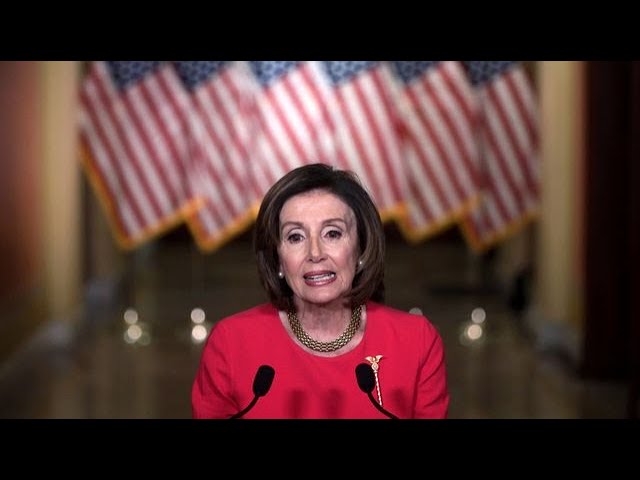
House Speaker Nancy Pelosi stepped outside her Capitol Hill office on March 23 to unveil a 1,400-page Democratic alternative to the emergency relief measure Senate Republicans had been pushing — and that Senate Democrats had just blocked for a second straight day. The package, titled the “Take Responsibility for Workers and Families Act,” carries a $2.5 trillion price tag and lands as Wall Street reels from the deadlock in the upper chamber.
Pelosi’s move isn’t a bill she expects to become law as written. It’s a marker meant to pull the bipartisan talks between Senate Majority Leader Mitch McConnell, Minority Leader Chuck Schumer and Treasury Secretary Steven Mnuchin closer to House Democrats’ priorities before the final package — what would soon take shape as the CARES Act — gets written.
- Pelosi’s $2.5 trillion “Take Responsibility for Workers and Families Act” runs 1,400 pages and was introduced March 23 outside her Capitol Hill office.
- The plan sets direct payments at $1,500 per individual, up to $7,500 for a family of five, alongside expanded unemployment benefits and funding for hospitals and state and local governments.
- Senate Democrats blocked McConnell’s bill on consecutive procedural votes over concerns it favored corporations over workers and lacked oversight, a standoff that helped trigger a sell-off in U.S. equities.
Inside the Democratic Counterproposal
The core of Pelosi’s bill is the direct-payment formula: $1,500 for every individual, scaling up to $7,500 for a family of five — a notably richer number than what Senate Republicans had floated. Beyond the checks, the package boosts and extends unemployment compensation, pours money into hospitals straining under the early wave of COVID-19 cases, and backstops state and local governments facing collapsing tax revenue.
The bill also builds in relief mechanisms for household bills that don’t stop during a lockdown — mortgage payments, rent, and car loans would all be eligible for delay under the House Democratic plan. It’s a broader menu than the corporate-liquidity-heavy approach Senate Republicans had been negotiating, and that’s precisely the contrast Pelosi wanted on the table.
Senate Bill Faces Legislative Impasse
McConnell’s measure hit a wall when Senate Democrats blocked it on back-to-back procedural votes, arguing it tilted too far toward corporate bailouts without enough strings attached and too little toward workers and oversight. That deadlock rattled markets already jittery over the pandemic’s economic toll, feeding a sharp drop in U.S. equities as investors watched Washington fail to move a rescue package fast enough.
“We must act now to help the American people. Staying on the sidelines is not an option.”
That urgency is exactly why Pelosi’s rollout mattered as theater as much as policy — it gave House Democrats a concrete document to point to while Schumer and McConnell kept negotiating, rather than simply objecting to the Republican text from the sidelines.
The Negotiating Track Ahead
Pelosi’s package was never destined to pass the Senate in its current form; Republicans control that chamber and had already signaled resistance to some of her broader spending priorities. Its real function was to reset the baseline for the Schumer-McConnell-Mnuchin talks, ensuring items like the larger direct payments, expanded jobless aid, and mortgage and rent relief stayed in the conversation as the two sides raced toward a final deal. That process — and the size of the eventual check Americans would see — became the next question hanging over Washington, one tracked closely as negotiations dragged on.
Mnuchin, Schumer and McConnell kept talking through the night after Pelosi’s announcement, working to close the gap between the Senate GOP framework and the House Democratic wish list before markets opened again. Whatever emerged next would need sign-off from both chambers and the White House — and with equities sliding every day Congress failed to act, the pressure to land a final number only kept building.





Small Business Loan program running out of money for small businesses
Coronavirus Spreads Before Symptoms Show
Kayleigh McEnany DESTROYS THE MEDIA EVERY DAY AND I LOVE IT
COVID-19 empties out New York
Coronavirus precautions lead to rat problem in New Orleans