

 InfoSearched
Congress just cut America the biggest check in its history to fight a pandemic no one saw coming a month earlier.
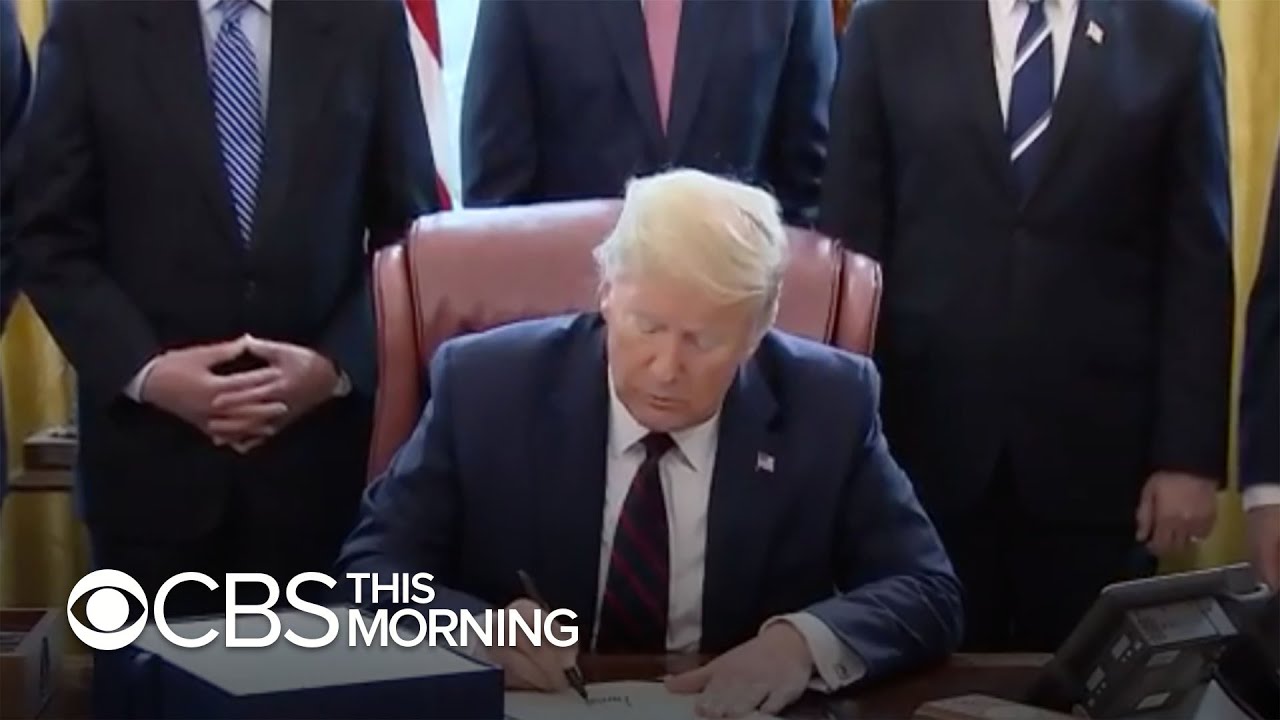
President Trump signed the Coronavirus Aid, Relief, and Economic Security Act into law in the Oval Office on the afternoon of Friday, March 27, 2020, just hours after the House cleared it on a voice vote. At $2.2 trillion, the CARES Act is the largest emergency economic rescue package ever enacted in the United States, built to keep workers paid and businesses alive as the COVID-19 shutdowns froze huge parts of the economy. The bill had already sailed through the Senate 96-0 following days of round-the-clock negotiations.
- The Senate passed the CARES Act unanimously, 96-0, after Senate Majority Leader Mitch McConnell, Senate Minority Leader Chuck Schumer, and Treasury Secretary Steven Mnuchin hammered out the final terms.
- Rep. Thomas Massie (R-Ky.) tried to force a recorded roll-call vote in the House, but the chamber ultimately passed the $2.2 trillion bill by voice vote.
- The package includes roughly $300 billion in direct payments of up to $1,200 per adult ($2,400 for married couples) plus $500 per child, $350 billion in Paycheck Protection Program loans for small businesses, about $250 billion in expanded unemployment insurance with an extra $600 a week, $500 billion in distressed-industry loans, more than $100 billion for hospitals, and $150 billion for state, local, and tribal governments.
Inside the Oval Office Signing
Trump signed H.R. 748 surrounded by a small, all-Republican group: McConnell, House Minority Leader Kevin McCarthy, Vice President Mike Pence, and Mnuchin. No Democratic leaders were present for the ceremony, even though the bill had cleared both chambers with bipartisan support. Trump used the moment to credit Congress for setting aside its usual fights, saying lawmakers had come together to put America first.
The Senate approved the measure 96-0 — a rare moment of total agreement in a chamber that almost never gets there.
Massie Nearly Forces Roll-Call Vote
The House’s path to passage wasn’t quite as smooth as the Senate’s. With most members scattered outside Washington to limit exposure to the virus, leadership wanted to pass the bill by voice vote rather than gather enough lawmakers for a formal roll call. Rep. Thomas Massie threatened to force that recorded vote anyway, a move that would have required members to fly or drive back into the Capitol during a national emergency. He backed down, and the House approved the bill by voice vote instead, sending it straight to the president’s desk.
Breakdown of Two Trillion Spending
The bill’s core promise to individual Americans is the $300 billion earmarked for direct stimulus checks — up to $1,200 per adult below the income thresholds, $2,400 for married couples, and $500 for each dependent child. Small businesses get $350 billion in forgivable loans through the Paycheck Protection Program, meant to keep workers on payroll rather than laid off. Unemployment insurance gets a $250 billion boost, adding $600 a week on top of state benefits and, for the first time, covering gig workers and freelancers who normally wouldn’t qualify.
Larger industries hit hardest by the shutdown — airlines, hotels, and other distressed sectors — are in line for $500 billion in loans, though those come with strings attached: no stock buybacks and caps on executive pay for companies that take the money. Hospitals and healthcare providers get more than $100 billion, and state, local, and tribal governments split $150 billion in relief funds. Readers tracking whether a follow-up round of checks might come later can see how that debate played out in Stimulus Check 2: When will the Next Stimulus Pass?
The Bipartisan Math Behind It
Getting a $2.2 trillion bill through a divided Congress in roughly a week required real horse-trading, not just goodwill. McConnell and Schumer went back and forth for days over the size of the corporate loan fund and the oversight attached to it, with Mnuchin shuttling between the two as the administration’s point man. The result was a package that satisfied enough Republicans worried about federal spending and enough Democrats worried about accountability for both a 96-0 Senate vote and a voice-vote House passage — a genuinely rare alignment as the country’s health response was still ramping up, as seen in moves like the White House directing staff to wear masks after officials contracted coronavirus.
The checks and the small-business loans are the pieces most Americans will notice first, but the real test comes in how fast the Treasury and the Small Business Administration can actually get that $350 billion in Paycheck Protection Program money out the door before more layoffs hit.





President Trump says reopening the country will be the “biggest decision” he’s ever made
Nurses Stop Anti-Lockdown Protesters from Blocking Hospital Access Roads amid COVID-19
Cannabis boom: Why Oklahoma is a ‘wild wild west’
Italy plans large-scale quarantine in response to coronavirus outbreak
U.S. first lady Melania Trump statue set on fire in Slovenia