

 InfoSearched
Two career diplomats told Congress, on camera, that withholding military aid from Ukraine put America’s own security at risk.
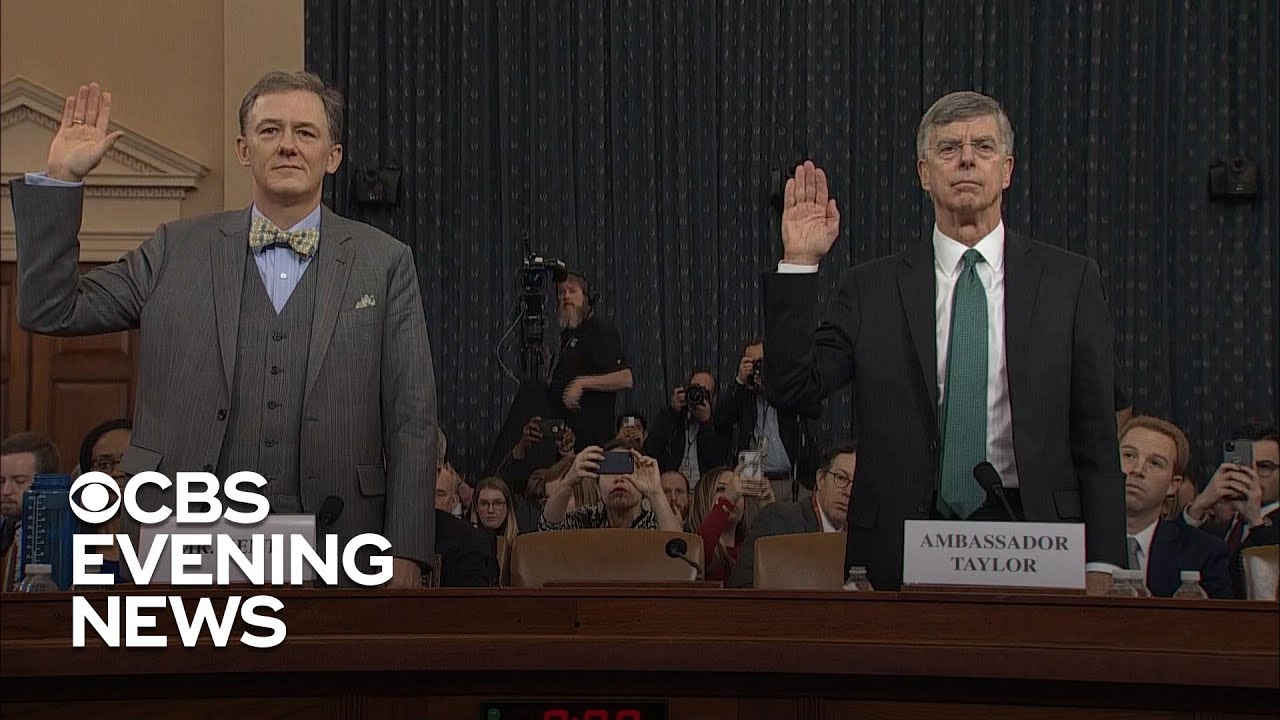
On November 13, 2019, the House Intelligence Committee opened the first televised impeachment hearings in more than two decades, and the two witnesses in the chair were not political operatives but career foreign service officers. Bill Taylor, the acting U.S. Ambassador to Ukraine, and George Kent, Deputy Assistant Secretary of State for European and Eurasian Affairs, walked lawmakers through how nearly $400 million in congressionally approved security assistance got tangled up with a demand for political investigations. Taylor opened with a disclosure nobody in the room had heard before.
- Taylor revealed that a member of his staff overheard a July 26 phone call between President Trump and Gordon Sondland, the U.S. Ambassador to the European Union.
- According to Taylor, when the staffer asked Sondland afterward what Trump thought about Ukraine, Sondland said the president “cares more about the investigations of Biden, which Giuliani was pressing for.”
- Both diplomats testified that withholding the nearly $400 million in security aid — paired with a withheld White House meeting for President Volodymyr Zelensky — amounted to a threat to U.S. national security, not just a political dispute.
Taylor’s New Disclosure
Taylor’s opening statement landed like a thunderclap because it was new information the committee hadn’t had before. He described the staffer’s account of the July 26 call as the first direct evidence tying Trump personally to a fixation on Ukraine announcing investigations into the Bidens, rather than the broader U.S.-Ukraine relationship that career diplomats had spent years building. The exchange, as Taylor relayed it, suggested Sondland understood exactly what the president wanted — and that it had nothing to do with anti-corruption reform.
Sondland told the staffer the president “cares more about the investigations of Biden, which Giuliani was pressing for.”
The $400 Million at the Center of It
The security assistance in question wasn’t a favor — it was money Congress had already approved to help Ukrainian forces resist Russian aggression that began with the 2014 annexation of Crimea. Taylor and Kent both testified that the aid, and the coveted White House meeting dangled alongside it, were leveraged to pressure Zelensky into publicly announcing investigations into political rivals. Taylor called the arrangement “crazy,” arguing that tying military assistance to domestic political investigations ran directly counter to America’s strategic interests in Eastern Europe.
The stakes of that region have been a recurring subject for diplomats and lawmakers well beyond this hearing, as detailed in coverage of why the U.S.-Russia standoff over Ukraine reached a critical moment. Kent, for his part, walked the committee through his own alarm as the freeze dragged on through the summer without explanation from the White House, even as Ukrainian troops remained engaged against Russian-backed forces in the east.
Diplomats, Not Partisans, in the Witness Chair
What set November 13 apart from the closed-door depositions that preceded it was who was doing the talking. Taylor and Kent are State Department career officials, not campaign staff or cable-news regulars, and both men framed their testimony around institutional concern rather than political score-settling. That framing put House Republicans and Democrats in the unusual position of cross-examining witnesses who had spent decades executing U.S. policy toward Moscow and Kyiv, not opposing it.
The hearing also arrived amid a broader argument in Washington over what impeachment proceedings should look like and who they should target, a debate that has surfaced again in other contexts, including calls like the one detailed in coverage of Rep. Alexandria Ocasio-Cortez’s push to impeach Justice Clarence Thomas. For Taylor and Kent, though, the argument on November 13 stayed narrowly focused on the aid freeze and its consequences for Ukraine’s ability to hold the line against Russia.
George Kent is scheduled to remain part of the committee’s ongoing record as more witnesses — including Sondland himself — are called in the days ahead, and Taylor’s account of the July 26 call is now the detail every subsequent witness will be asked to confirm, deny, or explain.



Trump Impeachment Hearing With House Judiciary Committee | Live!!
What Ohio Voters Want In The 2020 Election
Pres. Trump Cries ‘Bullsh*t’ As New Details Reported On Ukraine Aid Freeze – Day That Was | MSNBC
Tucker: Big Tech censors dissent over coronavirus lockdowns
Unease At Trump White House After Its Second Confirmed COVID-19 Case