

Chinese economy is going through transformation: BNP Paribas China CEO | East Tech West
 InfoSearched
Beijing is betting big on foreign capital to steer its economy through a rough patch.
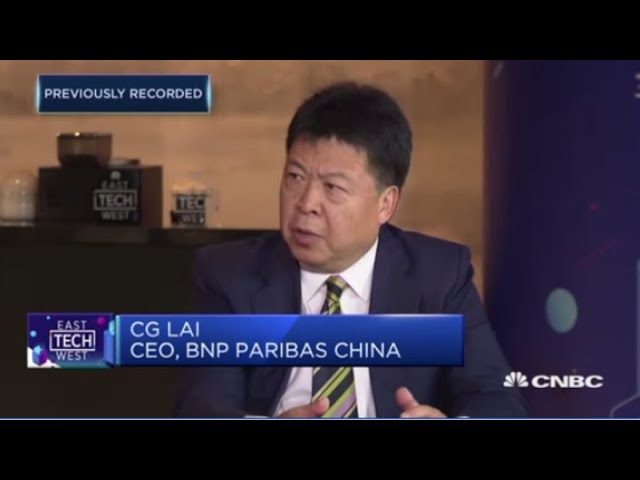
On the opening day of CNBC’s East Tech West conference in Nansha, Guangzhou, BNP Paribas China CEO CG Lai told correspondent Evelyn Cheng that he sees China’s economy moving through a genuine structural transformation — and moving in the right direction. Rather than dwelling on slowing growth headlines, Lai framed the moment as a deliberate opening of Chinese financial markets to foreign institutions, one he argued Beijing is actively pushing rather than merely tolerating. The interview, taped November 18, 2019, came as global banks watched China’s regulators loosen restrictions on market access.
- CG Lai, CEO of BNP Paribas China, spoke with CNBC’s Evelyn Cheng on Day 1 of the East Tech West conference in Nansha, Guangzhou, on November 18, 2019.
- Lai said he is “reasonably confident” the Chinese economy is on the right track as it undergoes a structural transition.
- He pointed to Beijing’s accelerating effort to open domestic financial markets to foreign institutional investors and global banks as a deliberate, motivated policy push.
A Structural Shift, Not a Slowdown Story
Lai’s framing pushed back against the narrative that China’s economy is simply cooling. Instead, he described a country in the middle of a deliberate structural transition — one where the mechanics of growth are changing even as the headline numbers get scrutinized abroad. That transition, in his telling, is a feature of Beijing’s strategy rather than a symptom of distress.
The confidence Lai expressed wasn’t framed as blind optimism. He tied it directly to concrete policy moves already underway: the loosening of foreign ownership caps in finance, expanded quotas for offshore investors, and a regulatory posture that treats global banks as partners in stabilizing markets rather than outsiders to be managed.
We’re reasonably confident that the Chinese economy is moving on the right track.
Opening the Door to Global Banks
Central to Lai’s remarks was Beijing’s push to bring foreign institutional investors and global banks deeper into its domestic financial markets. He described Chinese authorities as actively motivated to welcome these players — not simply permitting access under pressure, but courting it as a tool to deepen liquidity and refine credit and risk-hedging mechanisms.
That distinction matters for firms like BNP Paribas, which have spent years navigating China’s tightly controlled banking and securities sectors. Lai’s read is that the calculus in Beijing has shifted: foreign capital and expertise are now seen as necessary ballast for stabilizing capital markets, not a threat to sovereign control over them. It’s a theme that echoes broader U.S.-China friction over market access, the same tension that shaped Washington’s decision to end preferential treatment for Hong Kong earlier in 2019.
The Growing Importance of Liquidity and Hedging
Lai’s emphasis on liquidity, credit refinement, and risk-hedging wasn’t abstract banking jargon for its own sake — these are the exact tools Chinese markets have historically lacked relative to more mature financial centers. Deeper participation from global banks, in his framing, brings the kind of hedging instruments and credit-pricing discipline that can cushion volatility rather than amplify it.
That’s a notable pitch from inside the industry, delivered on stage in Nansha rather than in a boardroom memo, at a conference explicitly built around technology and finance in the Greater Bay Area. Not every foreign executive who has done business in China walks away with Lai’s optimism — some, as detailed in accounts of executives who left China for good, describe a far more difficult operating environment. Lai’s comments stood in contrast to that skepticism, betting instead that the regulatory direction of travel outweighs the friction points.
East Tech West itself, running its first day on November 18, 2019, put executives like Lai alongside tech and policy figures debating how far China’s opening would go — and how quickly foreign institutions would move to capitalize on it.





Flights for illegal immigrants cost taxpayers $340 million
Trump’s Baltimore battle threatens to overshadow strong economy
High tide in Venice could hit twice normal level
Warren insults Bloomberg after Nevada caucuses
NYC mayor warns residents to prepare for shelter-in-place order