

 InfoSearched
Trump tells Iran to stand down — and no one gets hurt.
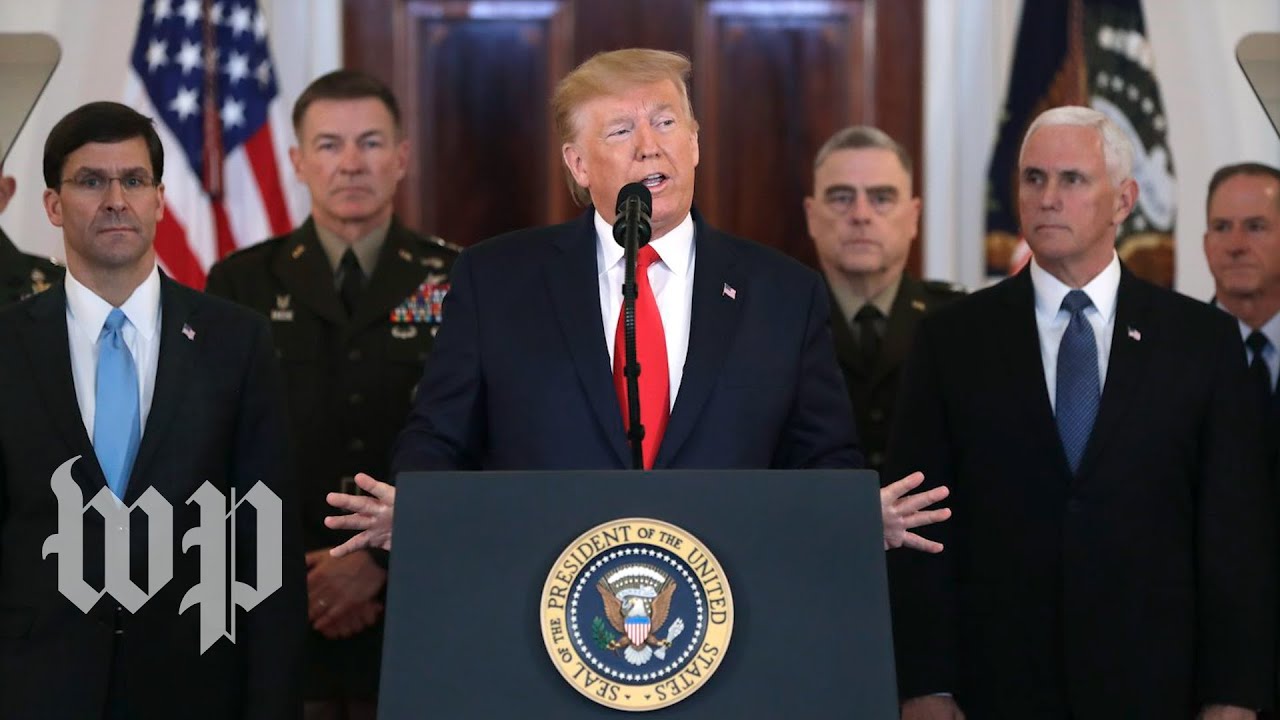
President Trump walked into the Grand Foyer of the White House on the morning of January 8, 2020, flanked by Vice President Mike Pence, Defense Secretary Mark Esper and his top military brass, to address a night that could have spiraled into open war. Hours earlier, Iran had fired a barrage of ballistic missiles at al-Asad Airbase and a facility in Erbil, Iraq — bases housing American and coalition forces — in direct retaliation for the January 3 drone strike that killed Islamic Revolutionary Guard Corps Quds Force commander Maj. Gen. Qasem Soleimani in Baghdad. What Trump announced instead of escalation was a pivot: sanctions, not strikes.
- No American or Iraqi personnel were killed or injured in Iran’s missile barrage on al-Asad Airbase and the Erbil facility, with only minimal damage to the bases.
- Trump declared Iran “appears to be standing down” and opted for new economic sanctions on Tehran rather than a military response.
- He called on the U.K., Germany, France, Russia and China to abandon the remaining JCPOA framework and pursue a new nuclear deal, while asking NATO to expand its role in the Middle East.
No Casualties, Minimal Damage
Trump opened his remarks with a direct statement of intent: “As long as I am President of the United States, Iran will never be allowed to have a nuclear weapon.” He then moved quickly to the operational details reporters and allied governments were waiting on overnight — whether American troops had been hurt. He credited early warning radar systems and the dispersal of forces across the bases for the outcome, telling the country, “We suffered no casualties, all of our soldiers are safe, and only minimal damage was sustained at our military bases.”
That accounting mattered enormously in the moment. Iran had launched more than a dozen missiles at facilities known to house American personnel, and the initial hours after the strikes had produced real uncertainty in Washington about the scale of losses. Trump’s confirmation of zero casualties reframed the rest of the address from crisis management into a case for restraint.
Standing Down Instead of Striking Back
Rather than announcing retaliatory military action, Trump used the address to signal de-escalation. “Iran appears to be standing down, which is a good thing for all parties concerned and a very good thing for the world,” he said. In place of strikes, he announced the U.S. would “immediately impose punishing economic sanctions on the Iranian regime,” which he said would stay in place until Iran changes its behavior.
“Iran appears to be standing down, which is a good thing for all parties concerned and a very good thing for the world.”
The sanctions-first approach followed the same playbook the administration had used throughout its “maximum pressure” campaign on Tehran, a strategy documented elsewhere in the administration’s broader dealings with adversaries abroad, including its posture toward Middle East policy at the United Nations.
A Call to Allies and NATO
Trump used part of the address to press U.S. allies and rivals alike on the nuclear file. He called on the United Kingdom, Germany and France — along with Russia and China — to walk away from what remained of the 2015 Joint Comprehensive Plan of Action and negotiate a replacement agreement with Iran. He also asked NATO to take on a larger formal role across the Middle East, a request aimed at spreading the burden of regional security beyond U.S. forces alone.
He closed on a conciliatory note aimed directly at Tehran: “The United States is ready to embrace peace with all who seek it.” The line was a deliberate counterweight to the tougher sanctions language earlier in the remarks, meant to leave the door open for negotiation even as new economic penalties were rolled out.
What happens next runs through Tehran’s response to the sanctions and whether European signatories keep working the JCPOA’s dispute mechanism or walk away as Trump requested. For now, the immediate military standoff that began with Soleimani’s killing on January 3 ended without a single American or Iraqi casualty — and Trump’s own line about Iran “standing down” was the closest thing to an off-ramp either side had signaled all week.

‘Resident Evil’ stuntwoman speaks out about injury, lawsuit l ABC News
A Man Drank 1 Bottle Rubbing Alcohol For COVID-19. This Is What Happened To His Brain.
‘COVID On My Face,’ Colleagues Fall Ill: NYC Doctors, Nurses Plead For Help
Senate blocks two anti-abortion bills as reproductive rights battle heats up
Children among 16 dead, 47 wounded in Chicago weekend shootings