

 InfoSearched
Wall Street’s own economists can’t agree on whether the record expansion still has legs.
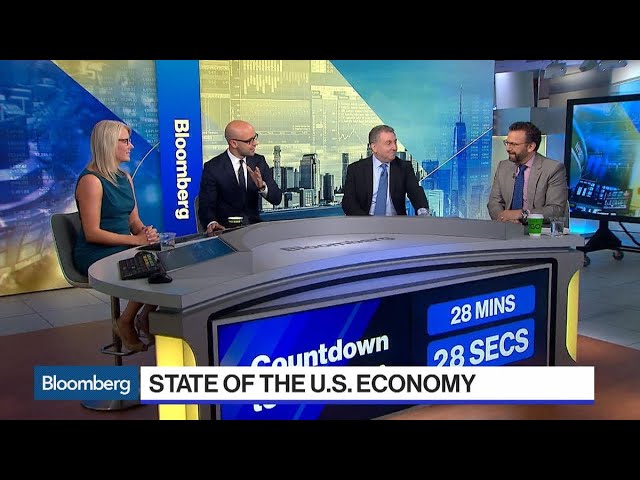
With the second-quarter GDP report fresh off the presses on July 26, 2019, Bloomberg Television pulled together three of the Street’s sharpest voices to hash out a question dividing trading desks all summer: is the U.S. economy cruising toward a soft landing, or is it running on fumes? Jim Caron of Morgan Stanley Investment Management, Emily Roland of John Hancock Investment Management, and Jonathan Golub of Credit Suisse laid out sharply different reads on the same data set.
- The panel discussion aired the same day the U.S. released its second-quarter GDP report, with strategists split on whether growth was decelerating or merely normalizing.
- Jim Caron (Morgan Stanley Investment Management), Emily Roland (John Hancock Investment Management), and Jonathan Golub (Credit Suisse) offered competing takes on consumer strength versus late-cycle risk.
- The conversation centered on whether the Federal Reserve’s expected rate cut at its late-July 2019 meeting would function as “insurance” easing or a signal of deeper trouble.
GDP Data Reveals Economic Growth
The strategists agreed on the raw ingredients even if they disagreed on the recipe. Consumer spending held up, unemployment sat near multi-decade lows, and consumer confidence readings stayed solid — the pillars that have kept the expansion alive deep into its record-setting run. Roland and Caron both pointed to the resilient American shopper as the load-bearing wall of the current cycle.
But the panel didn’t stop at the good news. Business fixed investment had softened, global growth was decelerating, and the trade fight between Washington and Beijing kept showing up as a drag in corporate commentary. Golub, representing the more bullish equity camp as Credit Suisse’s chief U.S. equity strategist, argued the domestic economy could keep absorbing those external shocks. Caron and Roland were less convinced the cushion would last if trade tensions or the global slowdown deepened further.
The Fed’s Insurance Question
The segment’s real tension point was the Federal Reserve’s looming late-July meeting and whether policymakers were about to cut rates as a precaution or because something was already breaking underneath the headline numbers. That framing — insurance cut versus warning sign — ran through the entire discussion.
Investors Split on the State of the U.S. Economy
Golub’s camp leaned into the insurance-cut reading: a modest, preemptive easing designed to keep a fundamentally sound expansion rolling rather than to fight off recession. Caron and Roland, more defensively positioned, treated the same prospective rate cut as evidence the Fed itself saw late-cycle cracks forming — in trade-exposed manufacturing, in softening capex, in the global growth slowdown feeding back into U.S. corporate guidance.
Bulls Versus Defense on Wall Street
What made the segment notable wasn’t just the disagreement — it was that it came from three well-credentialed strategists at major firms, not fringe voices. Golub’s bullish equity stance banked on the idea that low unemployment and steady consumer spending would keep outweighing the drag from trade conflict and slower global growth. Roland and Caron’s more defensive positioning reflected a growing camp on the Street bracing for the expansion’s late stages to bite, even if the timing remained uncertain.
That split mirrored a broader divide playing out across trading floors that summer, as fund managers debated how much of the rally still had room to run versus how much was priced for a slowdown that hadn’t fully arrived yet. For context on how policy decisions ripple through markets and everyday costs, see InfoSearched’s coverage of grocery prices on the rise and the ongoing debate over stimulus and fiscal policy timing.
The Fed’s actual decision was still days away when this panel taped, which is exactly why the disagreement mattered — Caron, Roland, and Golub were making their calls with the same GDP print in front of them and reaching opposite conclusions about what a rate cut would actually mean once it landed.




China denies accusations COVID-19 was made in a lab
Doctor With COVID-19 Describes Symptoms As ‘Pain Everywhere’
Arrests Made For School Shooting Threats In Oklahoma, California | NBC Nightly News
Seattle Just PURGED The CHAZ After Chazistani Police Kill Underage Black Male, Truly Stupid Times
A Video Message of Appreciation on the 2019–20 U.S. News & World Report Best Hospital Rankings