

 InfoSearched
Beijing draws a hard line against the lab-leak theory just a day after Trump says the U.S. is investigating it.
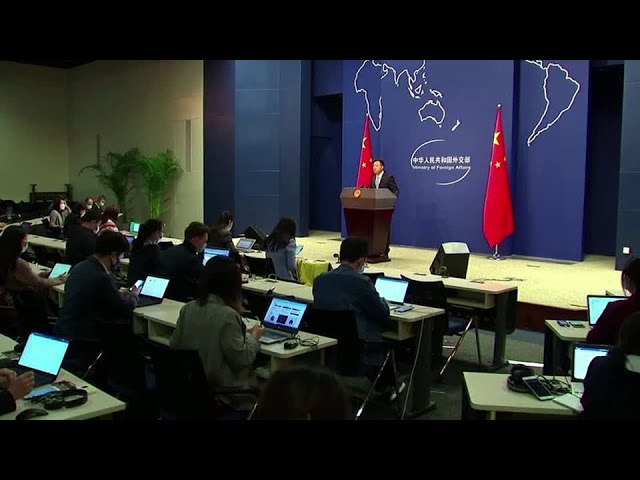
China’s Foreign Ministry used its daily press briefing in Beijing to shut down growing speculation that the novel coronavirus escaped from a laboratory in Wuhan. Spokesman Zhao Lijian told reporters there is no evidence to support the theory, framing it as a scientific question that politicians in Washington have no business answering. The rebuttal landed one day after President Trump confirmed his own government was looking into the same possibility.
- Zhao Lijian rejected lab-origin claims at the April 16 briefing, citing WHO statements and international medical experts as backing for China’s position.
- On April 15, President Trump publicly confirmed the U.S. government was investigating whether the virus accidentally escaped from the Wuhan Institute of Virology, with intelligence agencies assessing the facility’s role.
- Global deaths had passed 137,000 across more than 2 million confirmed cases, with the U.S. logging over 32,000 fatalities and China reporting 82,341 cases and 3,342 deaths.
Zhao’s Rebuttal at the Podium
Zhao Lijian didn’t hedge. Standing before reporters in Beijing, he said there was no evidence indicating the coronavirus was manufactured in or leaked from a lab in Wuhan, the city where the outbreak first surfaced in late 2019. He leaned on the World Health Organization and unnamed international medical experts to back the claim, arguing that assertions of a laboratory origin have no scientific basis whatsoever.
The spokesman drew a line between science and politics, insisting that pinpointing the virus’s origin is a job for researchers, not diplomats or cable news panels. He reiterated that Beijing wants international cooperation on the pandemic response, arguing that only a fact-based global effort — not speculation — could actually defeat the outbreak.
There is no evidence indicating the coronavirus originated in a lab in Wuhan.
Trump’s Escalation From Washington
The timing wasn’t an accident. Just a day before Zhao’s briefing, Trump told reporters the U.S. was actively investigating whether the virus accidentally escaped from a Wuhan facility, while American intelligence agencies worked to assess whether the Wuhan Institute of Virology was the source. That confirmation, paired with a wave of U.S. media reports and political commentary pointing to lax biosafety protocols at Chinese labs, gave the lab-leak theory a level of official attention it hadn’t had before.
It’s the kind of accusation that ties directly into ongoing questions about Dr. Anthony Fauci’s National Institutes of Health funding of bat-human interface research in China, which had already become a flashpoint in Washington before Trump’s remarks. Beijing’s pushback was designed to get ahead of that narrative before it hardened into consensus.
The Numbers Driving the Dispute
The stakes behind the diplomatic sparring were measured in bodies. At the time of Zhao’s remarks, the global death toll had crossed 137,000 across more than 2 million confirmed infections, with the United States alone recording over 32,000 deaths. China’s official tally stood at 82,341 confirmed cases and 3,342 deaths — figures Beijing has repeatedly cited as evidence its containment measures worked, even as it faced mounting criticism over early transparency.
A Wider Pattern of Friction
This wasn’t an isolated exchange. It fit a broader pattern of U.S.-China friction over the pandemic’s origins and Beijing’s early handling of the outbreak, tension that has bled into other flashpoints between the two governments, from trade to Hong Kong policy. Chinese diplomats have increasingly treated lab-origin theories as attacks on the country’s containment record rather than legitimate scientific inquiry, and Zhao’s briefing was the clearest articulation yet of that defensive posture.
Neither side showed any sign of backing off. Trump wanted answers on whether inadequate biosafety protocols at the Wuhan Institute of Virology triggered the outbreak, and Beijing’s position was that the WHO’s own findings already settled the question. With U.S. intelligence agencies still running their assessment and Chinese officials repeating the same denial at every briefing, the argument over where COVID-19 actually came from was nowhere close to resolved.
U.S. envoy talks Venezuela crisis ahead of international meeting
Trump slams China for hiding initial coronavirus information in press briefing
Why are Federal Reserve members split on raising rates? I FT
Why The Left Can’t Handle Donald Trump | Russell Brand
America Strong: The Women of CMA